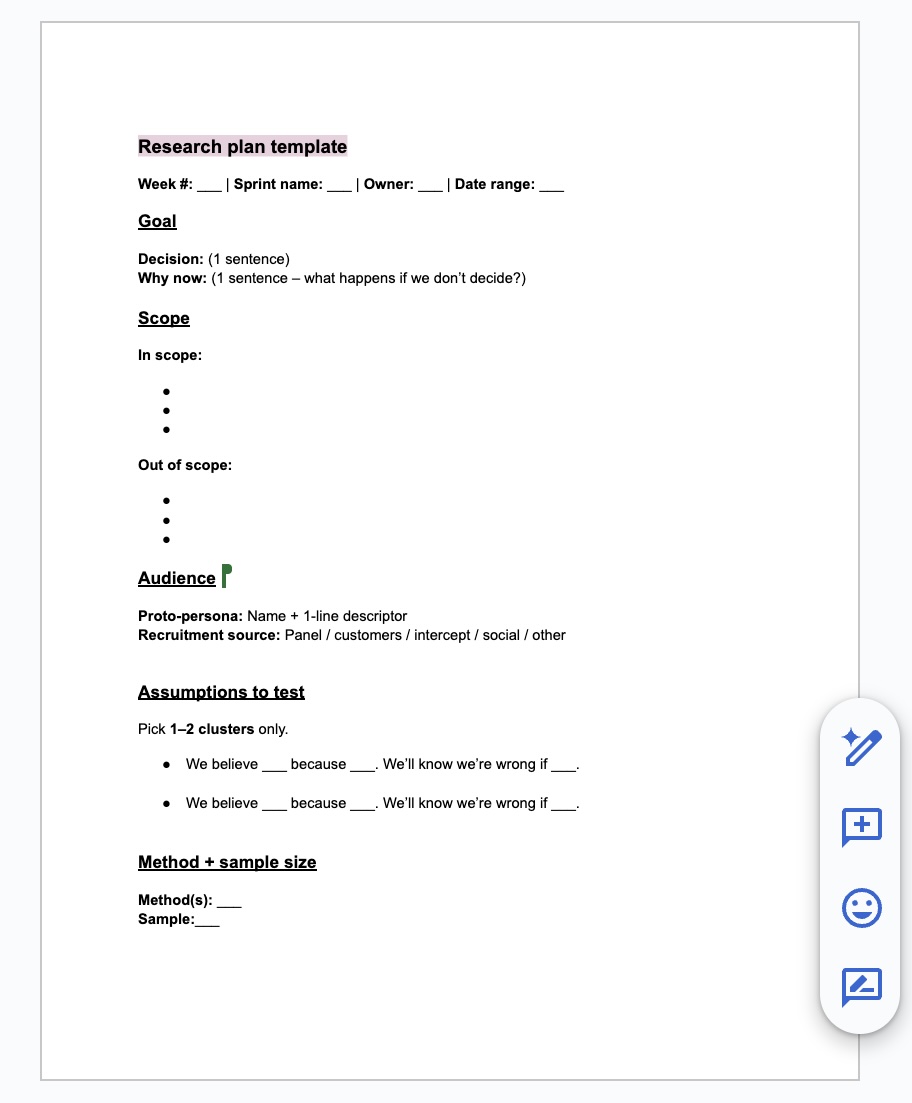
Don't leave your product's fate to the whims of chance or 'gut feelings. This card is your crystal ball for the sprint, turning murky assumptions into a clear vision in just five days
In product development, we often feel pressured to go big or go home. We design massive studies, recruit dozens of participants, and spend weeks analysing data. But by the time we have the results the product has moved on.
The one page plan method is designed to break that cycle. It’s a tool for moving from an assumption to a confident decision in just five days. Here is how to use it effectively.
The biggest risk in any project isn't making a mistake. It’s making one that takes longer to fix than it did to mess up. If your research question is too broad, your confidence in the data will be thin. By narrowing your focus to a single decision, you ensure the scale is right.
The secret to user centered product development is making lots of small decisions. It is significantly easier (and cheaper) to fix a small feature that missed the mark than it is to pivot an entire platform.
When filling out your card, be ruthless about what is out of scope. You don’t need to answer everything at once. If a question doesn’t directly serve the decision this week, save it for next week.
You don’t need a perfect persona to start. Use the audience section to plot your best guesses based on secondary data and existing assumptions. Don't worry about the ratio of facts to assumptions yet, just crack on and start.
The "Pro-Tip" for recruitment? Go where the people already are. If your users live on social media, don’t force them into a formal customer panel. Use existing communication channels to find the right people quickly.
The most powerful line on the card is: "We’ll know we’re wrong if..." If your stats don't budge or you keep seeing the same recurring friction, it’s a signal that you haven't hit the root cause.
Finally, don't just pick the method you're most comfortable with. Pick the one that collects the right data for this specific question. Whether it’s a quick usability test or a focused interview, the methods suggested in this framework are tried and tested for the one-week cycle. They are the foundation of understanding user behavior without the bloat.
Now define what success looks like. Use the framework to measure everything from satisfaction to tasks