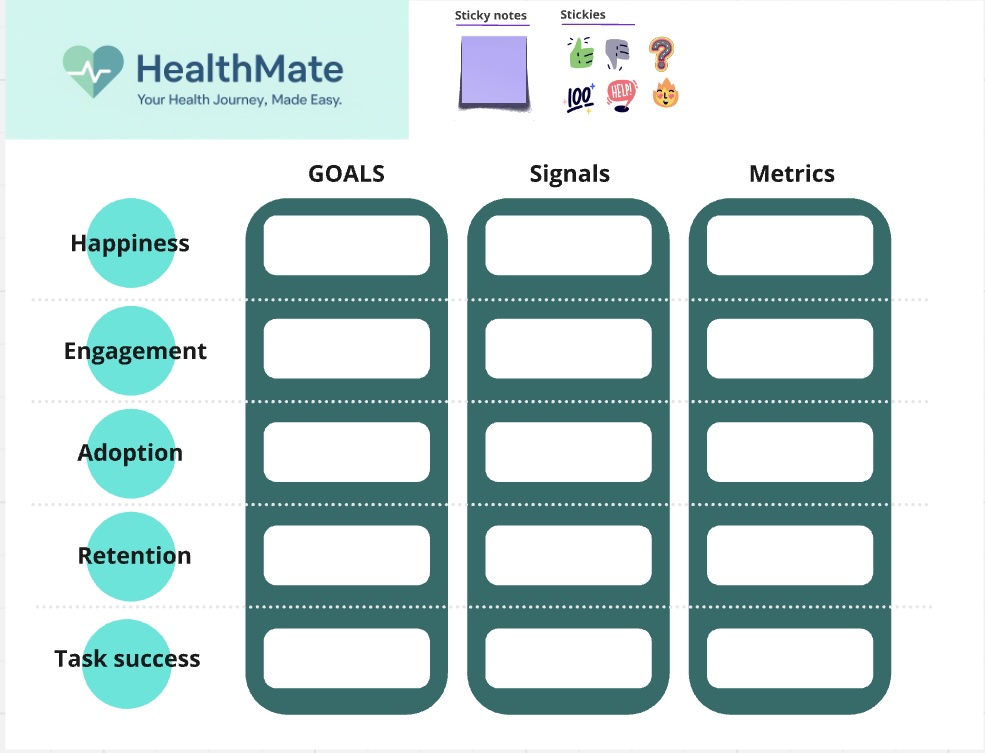
The HEART Frasmework is a simple way to measure user experience without drowning in vanity metrics. It helps you translate “we think it’s better” into clear signals your team can track and improve over time.
Look, I’m not going to pretend I invented the HEART framework—Google did. But if you aren’t using it as a primary tool in your arsenal, you’re essentially flying blind.
Think of HEART as the MVP for success metrics. We spend so much time building MVPs for products, yet we forget to build a scalable way to measure if they actually work. You need success metrics because, frankly, how else do you know you’ve "achieved your thing"? You need different data sets to answer different questions, and you need those measures to scale as your product grows. Without a framework, you’re just collecting "noise" and calling it "data."
01. Happiness
If you track only one thing here, make it First-Time Success. It’s a bit of a "cheat" because it overlaps with other categories, but it’s the ultimate pulse check on whether a user feels capable or frustrated the moment they meet your tool.
02. Engagement
Engagement isn't just about "clicks"; it's about the depth of the relationship. We look for the patterns that show a user isn't just visiting, but actively weaving the tool into their daily workflow.
03. Adoption
This is your "Newness" gauge. Are people actually trying the new features you spent six weeks building? Adoption tells you if your onboarding is working or if your new releases are invisible.
04. Retention
The "Churn-Killer." We want to know if the value we promised on day one is still there on day 100. If retention is low, your product has a "leaky bucket" problem that no amount of marketing can fix.
05. Task Success
Focus on Accuracy over Speed. While a prolonged interaction is annoying, humans have a famously low tolerance for errors. Too many mistakes lead to abandonment—you’re practically handing your users to a competitor. In the public sector, this is even more critical; poor task success creates "cottage industries" of manual workarounds and offline fixes that drain resources.
I’m starting to hear more about AI in user interviews every day. I don’t think AI changes what "success" looks like, but it fundamentally shifts the experience of getting there—especially when users rely on AI for advice or decision-making. It’s about learning what you can control in an automated world and ensuring the "machine" doesn't break the human connection.
If you’re a lead designer or product owner wanting to start tomorrow, here’s my advice: Don’t wait for a data expert. Start with a measure that doesn’t require complex analytics. Use a Reduced System Usability Scale (SUS).
It’s a cheap, repeatable survey that focuses on the practical aspects of UX. You don’t need a massive infrastructure to track it, and there are plenty of tools to help you analyze the results.
Ready to get started?
If you add an additional call onto the HEART framework, I’ll set you up with your own survey and personally show you how to analyze the data to find your "North Star."
Let's talk sample size. Now you have an idea of the methods and success, we need to figure out how many people we need to give you confidence in your product sucess.