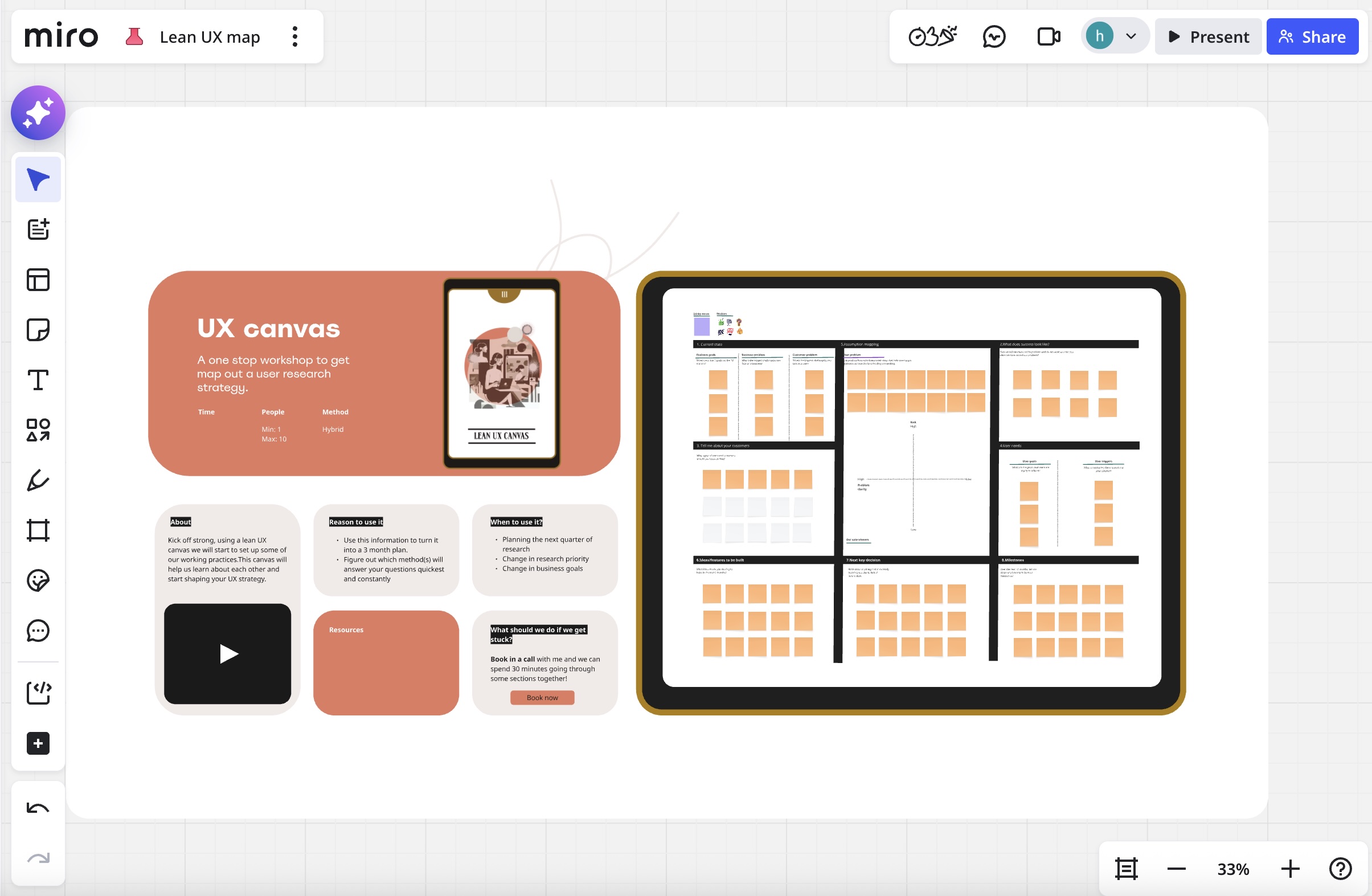
Feeling ready to get started? Then, grab a coffee (or whatever your work poison of choice is) and set that ten minute timer. If you’re doing this as a group, spend the first ten minutes chatting through the 8 boxes and take a go/no go vote. I vote…GO!!
We’ve all seen the two fates of a product roadmap.
In the best-case scenario, it’s a weapon for productivity. In the worst-case (and most common) scenario, it’s a "lost relic" buried deep in a SharePoint folder, gathering digital dust while the team flails in the dark.
If you’re a Product Manager or Researcher feeling the heat, stop "flapping." Flapping won't pay your mortgage, and throwing money into features that die a sad, lonely death won't impress your stakeholders.
You don't need a longer roadmap. You need to make your thinking visible. You need the Lean UX Canvas.
What happens when a team doesn’t make their thinking visible
Chaos.
Not the loud, obvious kind of chaos, but the quiet, expensive kind. It’s the breakdown of communication. It’s the "wasted time" spent in circular meetings where everyone thinks they are on the same page, but no one actually is.
The Canvas is a survival tool because it creates a "Shared Brain." By getting everyone into a room (or a Miro board) to discuss ideas in an equal space, you force a pace that prevents overthinking. It’s a facilitation tool designed to shift the conversation from outputs (what are we building?) to outcomes (why are we doing this?).
In our workshops, we use a ten-minute timer for the "go/no-go" vote.
Why? Because by the time you’ve mapped your assumptions, you already know the answer. We need to trust our gut instincts more. Product discovery isn’t a court case; it’s an experiment. Speed and "good enough" beat a two-hour deep dive every single time. Get it out of your system, make a choice, and move.
Step 5 of the Canvas is the moment of truth: Assumption Mapping. This is where things get uncomfortable. As a researcher, it’s my job to help the team manage risk. Often, that means telling someone their "favorite feature" is actually a high-risk, low-clarity gamble.
The trick to surviving this conversation? Don’t talk about the feature; talk about what the feature represents. When you detach the emotional weight from the idea, you can objectively decide if it’s worth the business's money. We aren't here to build things no one wants to use.
The biggest pitfall of any framework is "Canvas Fatigue." People strive for perfection in every box, creating a beautiful document that "dies a lonely death" in Miro the moment the session ends.
Forget perfection. Focus on function. The outcome of a Canvas shouldn't be a pretty picture; it should be a series of proportionate research plans. These aren't "War and Peace." They are small, scalable actions that you can run at any time to answer specific questions.
If you’re a stressed-out PM, remember: Stakeholders don't care about your "process." They care about results. The Lean UX Canvas is how you ensure that the features you do build actually survive in the wild.
Stop over-filling the boxes. Get the ideas out, map the risks, and start building the bridge.
Now you're ready to plan, 1 plan per question. Keep the scale small.