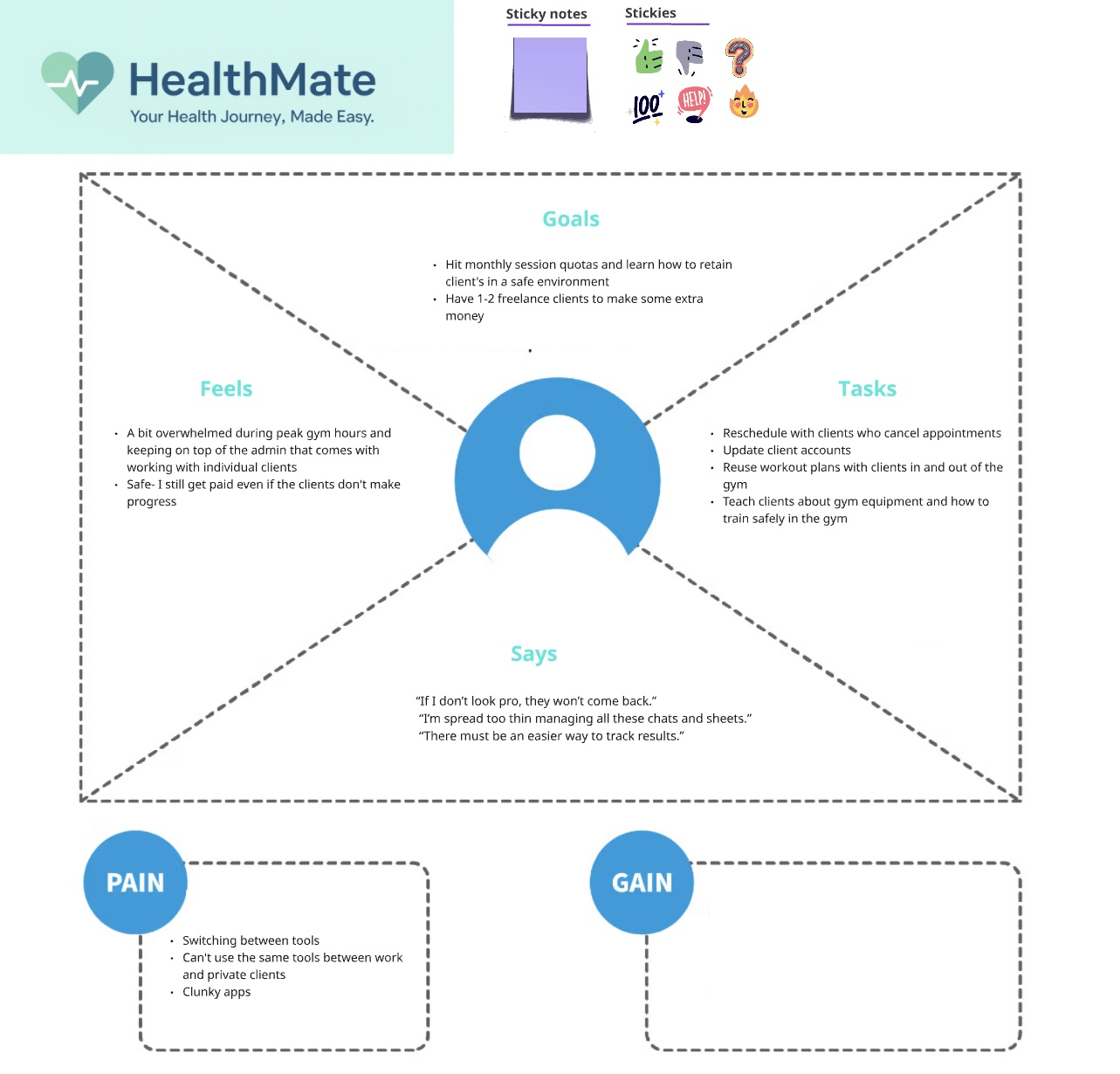
A user profile is a set of behaviours and attributes associated with a certain customer. We will group the information we get from both our quant and qual data to build your user profiles But for month one, these profiles are built for one purpose only. To write a recruitment survey.
An Empathy Map is a fancy way of saying: "Here is the ground truth of what our users are actually experiencing."
While journey maps help us sort data in the order people meet an action, Empathy Maps organize the internal data.We don’t do research for the sake of it; we do it to shrink the gap between what you think users want and what they actually need.
If your team is saying things like "We already know our users" or "People don't do that," an Empathy Map is your best weapon. It’s the evidence you bring to the party to prove that your "intuitive" design might actually be causing frustration. It’s about bringing data to the party so we can decide how to fix the friction.
It's also a tool I use for recruitment. It helpe me figure out where to find my users and how to best communciate with them. Using your outputs throguhout your user journey is the best kept sectret. They're pratcial tools, not pretty visuals.
1.Identify decision-making moments
Map the emotional "forks in the road." When does a user feel a surge of "Ick" or confusion? If your product supports their emotional state at that moment, they’ll glide through. If it doesn't, they’ll stall.
2. Bridge the "expectation gap"
Users arrive at your product with assumptions based on past experiences. Our research sprints use empathy maps to identify those expectations so we can refine the interaction before you waste money building the wrong thing.
03. Build for natural behavior
. When your design supports natural user behaviors and emotional triggers, adoption and engagement skyrocket.
04. Map findings to real reactions
Map failures to the empathy map. Is the user frustrated because of a slow load time, or because the language you used made them feel "not smart enough" to use the tool? That’s the insight that actually fixes the problem.
05. Create Decision Diagrams from Empathy
Personas are great for knowing who the user is, but Empathy Maps show us how they feel during the choice. These emotional insights stay stable over time, making them a powerful tool for your long-term product strategy.
Is using Empathy Maps critical to every single project? No. But when you back them with strong user data, they become an invaluable tool for designing user-friendly experiences without needing ten rounds of expensive, slow-moving research.
At SprintDecks, we don’t just "study" empathy; we use it to help teams make faster, smarter decisions. We’re looking for those "human moments" that a spreadsheet can't capture. We want to help you build something that feels familiar, works perfectly, and respects the way people actually think and feel.
Try and build out a screener for using in your next round of research so you can give yourself the best start to a successful research study.